

A beach house or holiday weekender has a fundamentally different design brief from an everyday home. It needs to accommodate more people than usual, handle the wear of guests and children, feel immediately relaxing the moment you arrive, and work well without the level of maintenance a permanent home receives. It also has the significant advantage of a view, which, when handled well, becomes the most powerful design element in the space.
The most successful holiday homes are the ones where the design decisions were made with the specific rhythms of holiday living in mind rather than adapting everyday home principles to a different setting. Here is how to approach the key decisions.

The most coherent interiors often begin not with a colour palette or a style direction but with a single significant piece that sets the tone for everything that follows. In a holiday home this starting point is particularly valuable because it gives the whole design a clear reference point that every subsequent decision can be tested against.
A vintage sofa with a distinctive character. A dining table with a history. A light fitting that defines the mood of the room it hangs in. Whatever the piece, the discipline is to choose it first, place it, and then build the palette, the materials, and the supporting furniture around it rather than the other way around.
This approach produces rooms that feel collected and personal rather than assembled from a catalogue, which is exactly the quality a holiday home should have. The best weekenders feel as though they have been accumulated over time by someone with a clear sense of what they love, even when the reality is a single considered renovation.
One of the most striking and surprisingly accessible feature wall techniques involves slicing a single marble slab in half to create two thinner pieces, then positioning them side by side with the veining in mirror image. The result is a symmetrical, butterfly-pattern composition that reads as a piece of abstract art rather than simply a tiled wall.
This technique works particularly well in living rooms, behind a bed in a master bedroom, or as a bathroom feature. The key is choosing a marble with strong, directional veining where the mirror effect will be dramatic. Subtle, uniform marble produces a much less striking result. Beaumont Tiles can advise on suitable marble varieties for this application and whether the specific slab you are considering has the veining movement needed to make the technique work.
A beach house used primarily on weekends and during school holidays has a completely different pattern of use from an everyday home. It accommodates more people simultaneously, those people are more relaxed and less careful, children are more active and less supervised, and the space needs to feel immediately restoring the moment you arrive rather than requiring effort to settle into.
These priorities change several design decisions. Flooring should be durable and easy to clean, timber or tile rather than carpet, with rugs that can be taken outside and shaken. Upholstery should be in performance fabrics that handle sand, sunscreen, and wet swimmers without distress. Storage should be generous and accessible for the range of equipment that comes with beach living, boards, wetsuits, towels, outdoor games. And the kitchen should be efficiently designed for feeding more people than usual without requiring a professional setup.
At the same time, the home should feel genuinely relaxing rather than merely functional. The balance between practicality and comfort is the central design challenge of a holiday home, and getting it right requires thinking honestly about how the space will actually be used rather than how you imagine it might be used.
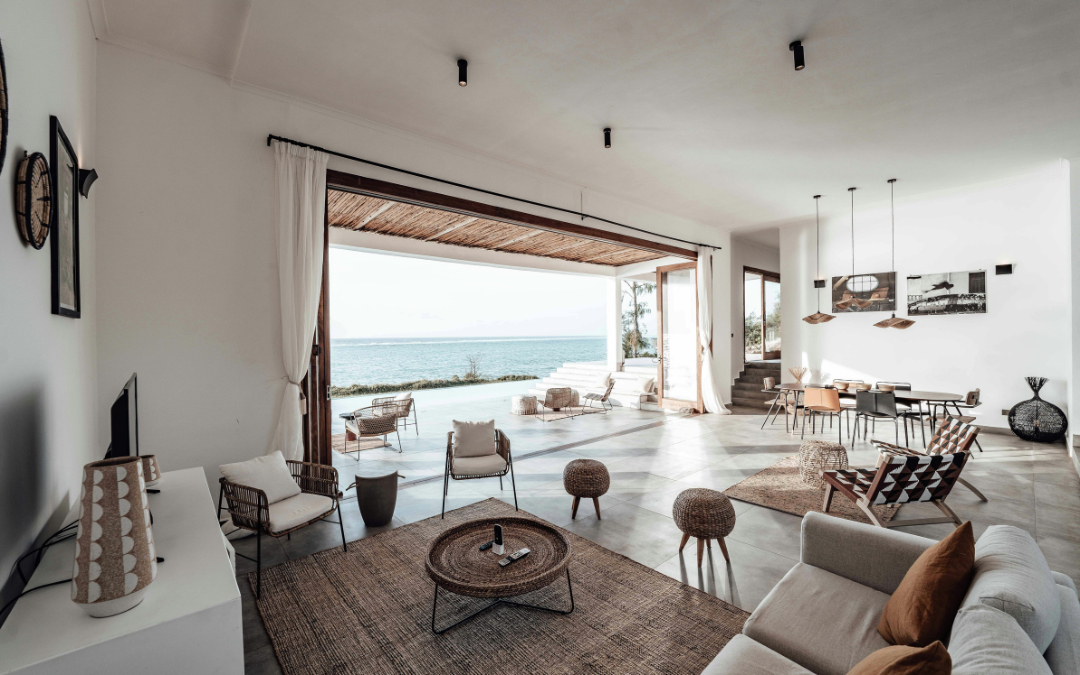
In any home with a significant view, the most important design decision is ensuring that every seating arrangement, every window treatment, and every major furniture piece is oriented to make the most of it. The view is the most powerful feature in the room and everything else should support rather than compete with it.
This means keeping window treatments simple and light-filtering rather than heavy and room-darkening. It means positioning sofas and dining tables to face toward the view rather than toward each other. It means choosing light fittings, particularly above dining tables, that provide enough illumination without sitting at a height that interrupts the sightline to the view when you are seated.
A common mistake in homes with spectacular views is to fill the interior with enough visual interest that the view becomes just another element competing for attention. The better approach is restraint: a simpler interior that frames and defers to the view rather than competing with it.
The marble bath is one of the most visually beautiful fixtures available in a bathroom, and one of the most practically disappointing. Marble is a poor thermal conductor, which means a marble bath loses heat quickly and is cold to the touch when you first step in. It also requires more maintenance than cast iron, acrylic, or stone resin alternatives.
This is worth knowing before committing to any beautiful but potentially impractical fixture. The most honest approach to bathroom material selection is to research the practical performance of every material you are considering alongside its aesthetic appeal. A bath that looks beautiful but cannot be used comfortably for more than ten minutes before the water goes cold is not a successful design decision, regardless of how it photographs.
Cast iron baths retain heat superbly and have the same visual weight and quality as marble. Stone resin baths are warm to the touch, durable, and available in a wide range of forms. Both are worth considering alongside marble when making this decision.
A beach house with children in it deserves children's spaces that are as considered as the adult spaces. Built-in bunk beds are one of the most efficient and characterful solutions for holiday homes where multiple children need to share a room, and the format lends itself to genuinely creative details.
Porthole windows between adjacent bunks, for example, create a playful connection between sleeping spaces that children find delightful and that costs very little to include if planned from the start. A wallpaper on the ceiling rather than the walls turns the surface children stare at while lying in bed into the most interesting element in the room. Built-in storage beneath and beside the bunks handles the gear that accumulates in a child's holiday space without creating the clutter that makes the room feel small.
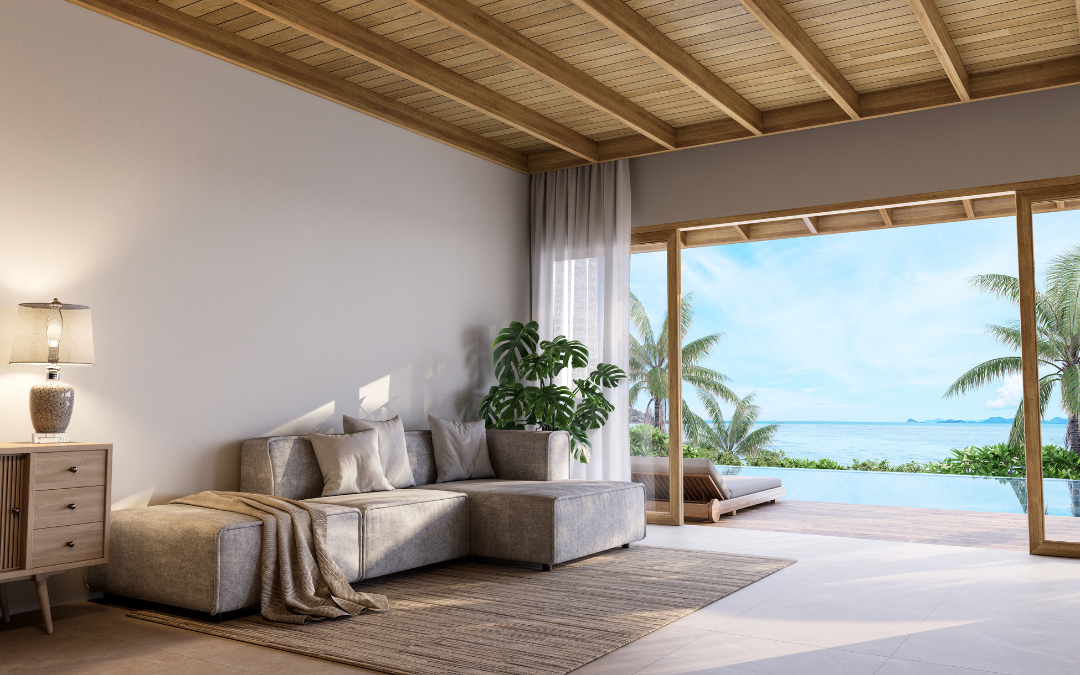
In a holiday home where the design needs to feel relaxed and personal rather than precisely coordinated, one of the most effective approaches is to choose a single textile with a strong character and build the entire room's colour palette from the tones within it.
A grass cloth wallpaper in a soft mauve. A vintage patchwork rug with multiple colours in play. A woven cushion fabric with earthy tones and organic pattern. Whichever textile anchors the room, the discipline is to choose the wall colour, the rug, the curtains, and the accessories by pulling specific tones from that textile rather than introducing any colour from outside it.
This approach produces rooms that feel cohesive without feeling colour-matched, which is exactly the quality a holiday home should have. Armadillo produces woven and natural fibre rugs in a range of tones and patterns that work well as an anchor textile in coastal and holiday home settings.
A clean white interior paired with dark timber is one of the most reliably successful palettes for a coastal holiday home. It reads as bright and airy in full sun, warm and atmospheric in the evening, and it never feels overdone or trend-dependent. The white provides the freshness and light reflection that a beach or water-adjacent location calls for. The dark timber provides the warmth and weight that prevents the white from feeling clinical.
The key to making this palette work is ensuring the white has warmth rather than a cool or blue undertone, and that the timber is used generously enough to balance the white rather than appearing as an accent. Teak, walnut, and dark-stained oak all work well. The combination suits both mid-century and contemporary architectural styles and wears well over time. Dulux has an extensive range of warm whites suited to coastal environments where light conditions change significantly throughout the day.
The most successful beach houses and holiday weekenders are the ones where the design decisions were made with genuine understanding of how the space would actually be used and by whom. Practical enough to handle the reality of holiday living without feeling institutional. Personal enough to feel like somewhere that belongs to someone. Relaxed enough to feel like a genuine escape the moment you arrive.
If you are planning or renovating a holiday home and would like help thinking through the design decisions, get in touch. Holiday homes are some of our favourite projects to work on.


